Jyoti
Jyoti
G-INEWS, New Delhi : In a breakthrough that could significantly enhance the driving range of electric vehicles (EVs), researchers from the Department of Engineering Design at the Indian Institute of Technology Madras (IIT Madras) have developed an analytical method to make regenerative braking smarter, more efficient, and easier to implement in real-world vehicles.The research team—Ms. M. K. Deepa, Prof. Srikanthan Sridharan, and Prof. Shankar C. Subramanian—has introduced a novel approach to accurately determine the Low-Speed Cutoff Point (LSCP) in EV traction systems.
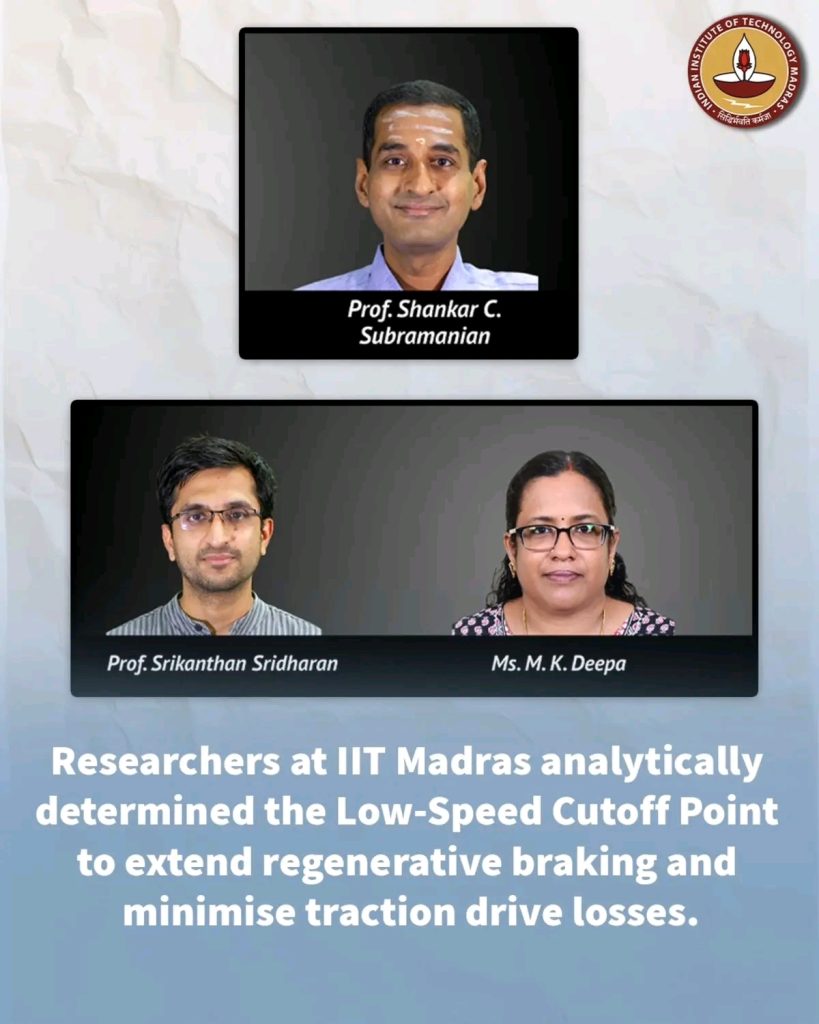
The LSCP defines the threshold below which regenerative braking becomes ineffective due to motor and inverter limitations.What Makes This Innovation Different?Unlike many global approaches that rely heavily on real-time artificial intelligence, predictive control, or complex sensor networks, the IIT Madras team adopted an offline analytical computation method.
This enables : Precise determination of the optimal braking windowExtension of regenerative braking operationReduction in traction drive lossesLower computational and hardware complexityThe researchers also validated a robust Model-based Loss Minimising Algorithm (LMA) that accounts for variations in motor parameters, ensuring reliability across different driving conditions.
Proven Efficiency GainsThe study reported measurable improvements:13% reduction in system losses under the Modified Indian Driving Cycle (MIDC)7% reduction under the US EPA Highway cycleThe gains are especially notable under low-torque, high-speed driving conditions, where conventional systems typically suffer higher inefficiencies.Why It Matters Regenerative braking plays a crucial role in energy recovery in EVs. Even small efficiency improvements can lead to:
Extended driving range
Reduced battery stressImproved thermal performanceLower operational costsBy eliminating the need for AI-heavy real-time optimization, the IIT Madras solution could be more cost-effective and scalable for emerging EV markets like India.With EV adoption accelerating globally, this development strengthens India’s position in advanced electric mobility research and highlights how analytical engineering can deliver practical, high-impact innovation.
How Does This Compare with Global Research?
Globally, regenerative braking optimization has been an active research area, particularly in Europe, the United States, China, and Japan.
🇺🇸 United States – AI & Predictive Control ApproachesResearch institutions such as the Massachusetts Institute of Technology and industry leaders like Tesla, Inc. have focused on:Real-time predictive energy managementAI-driven torque distributionMachine-learning-based adaptive braking strategiesThese systems use real-time vehicle data, GPS mapping, and traffic prediction to optimize energy recovery dynamically. While highly adaptive, such approaches increase computational complexity and hardware requirements.IIT Madras’ Advantage:Instead of AI-heavy systems, IITM’s offline analytical solution simplifies implementation and reduces cost—making it highly suitable for emerging EV markets like India.
🇩🇪 Germany – Integrated Powertrain OptimizationAutomotive research groups in collaboration with companies like Robert Bosch GmbH and BMW AG have developed integrated braking-energy recovery systems combining:Brake blending algorithmsMotor-inverter co-optimizationThermal-aware loss minimizationThese systems are sophisticated but often tuned for high-performance EV architectures.IIT Madras’ Distinction:The focus on precise Low-Speed Cutoff Point modeling is a relatively underexplored area globally. By extending the braking window through loss-aware modeling, the IITM approach addresses a practical inefficiency often overlooked in real-world driving.
🇨🇳 China – High-Efficiency Motor Control StrategiesChinese research institutions, including collaborations with companies like BYD Company Limited, emphasize:Advanced inverter topologiesWide-speed-range motor efficiency mappingHigh-frequency switching strategiesWhile these methods improve overall motor efficiency, they often require hardware redesign or advanced semiconductor technologies.IIT Madras’ Strength:The proposed algorithm works within existing hardware architectures, relying on mathematical optimization rather than hardware upgrades—making it scalable and cost-effective.
Why This Research Matters for India
India’s EV ecosystem is rapidly expanding under national electrification initiatives. However, cost sensitivity and hardware simplicity remain key constraints. An approach that:Enhances range without adding expensive componentsImproves efficiency in Indian driving cycles (MIDC)Avoids computational overheadis particularly valuable for domestic manufacturers.By demonstrating measurable efficiency gains under both Indian and US driving cycles, the IIT Madras team has positioned this research at a globally competitive level.
The Bigger Picture
As EV adoption accelerates worldwide, incremental improvements in traction drive efficiency can significantly impact:Battery lifeThermal performanceVehicle costCharging frequencyThe IIT Madras research shows that innovation does not always require complex AI or hardware expansion. Sometimes, precise analytical engineering can deliver comparable—or even superior—efficiency gains.With smarter regenerative braking and extended energy recovery windows, this development strengthens India’s footprint in advanced EV powertrain research and signals that Indian institutions are contributing meaningfully to global electric mobility innovation.
Smarter braking. Longer range. Better performance.
AI Revolutionizes India’s Environmental Protection: A New Era for Air and Water Safety